


SOD1 G93A Mice vs. rNLS8 TDP-43 Mice for ALS Studies
How the two leading ALS mouse models differ in construct validity, disease timeline, cohort size and endpoint selection.
 What are SOD1 G93A and rNLS8 TDP-43 mice?
- How well does each model match the pathology of human ALS?
- How do onset, progression, and reversibility differ between the two models?
- Why has SOD1 G93A shown limited clinical translation?
- How does model choice affect study duration and cohort size?
- What can Biospective measure in rNLS8 TDP-43 mice?
- SOD1 G93A or rNLS8: which ALS model is right for your therapeutic program?
Summary
In brief: SOD1 G93A mice are widely used as an animal model of ALS, but SOD1 mutations account for only about 1.2% of sporadic and 14.8% of familial ALS cases in European populations (Zou, 2017). Human SOD1-mutant cases characteristically lack the TDP-43 inclusions found in sporadic and non-SOD1 familial ALS cases (Mackenzie, 2007). In contrast, rNLS8 hTDP-43ΔNLS mice reproduce the cytoplasmic TDP-43 proteinopathy characteristic of most human ALS, with disease onset initiated by doxycycline withdrawal and several disease-associated features reversed when the transgene is suppressed after onset (Walker, 2015). Pooled SOD1 mouse trials showed weighted mean survival gains of 13 days with presymptomatic treatment and 15 days with treatment initiated at symptom onset, without yielding an effective human therapy (Benatar, 2007). Choose SOD1 G93A for SOD1-directed candidates; for programs addressing TDP-43 biology, rNLS8 is the better default model.
Video 1: The model choice in 60 seconds. TDP-43 versus SOD1 pathology, inducible onset, pooled SOD1 treatment effects and the human concordance map for the rNLS8 TDP-43 and SOD1 G93A mouse models of ALS.
 Click to copy link
What are SOD1 G93A and rNLS8 TDP-43 mice?
SOD1 G93A mice are transgenic mice that overexpress mutant human superoxide dismutase 1 (SOD1), while rNLS8 mice are bigenic mice in which human TDP-43 lacking a functional nuclear localization signal (NLS) is regulated by doxycycline.
The two lines model ALS through entirely different proteins, and that difference determines which therapeutic questions each model is best suited to address.
The SOD1 G93A mouse
The SOD1 G93A line expresses high levels of human SOD1 carrying a glycine-to-alanine substitution at position 93, a change that has little effect on enzyme activity. These mice develop spinal cord motor neuron degeneration, limb weakness and paralysis, and typically die by five to six months of age. This model provided key evidence that dominant SOD1 mutations cause ALS through a gain of function rather than loss of dismutase activity (Gurney, 1994). This model has been used extensively since its development in 1994, and many preclinical ALS protocols have been developed using it (Mead, 2011).
However, its phenotype is strongly influenced by transgene copy number and expression level. The standard high-copy line carries up to 25 transgene copies and typically dies at around 130 days. In contrast, a very low-expressing line carrying only four copies exhibits a markedly attenuated phenotype: weakness may not emerge until nine months of age, only 74% of mice are affected by 18 months, and roughly 20% of mice surviving beyond 24 months show no motor symptoms (Deitch, 2014).
Low Dox rNLS8 Model
Biospective's proprietary Low Dox rNLS8 line keeps the TDP-43 pathology of the standard model while stretching the window in which a candidate can be dosed and an effect detected.
TDP-43 Pathology
The model reproduces the cytoplasmic TDP-43 proteinopathy that defines the large majority of human ALS cases, and clears it when the transgene is suppressed.
Inducible Disease Onset
Withdrawing doxycycline starts disease on your schedule, so cohorts are induced synchronously and treatment begins at a defined point relative to onset rather than to age.
Low Dox rNLS8 Model
Biospective's proprietary Low Dox rNLS8 line keeps the TDP-43 pathology of the standard model while stretching the window in which a candidate can be dosed and an effect detected.
TDP-43 Pathology
The model reproduces the cytoplasmic TDP-43 proteinopathy that defines the large majority of human ALS cases, and clears it when the transgene is suppressed.
Inducible Disease Onset
Withdrawing doxycycline starts disease on your schedule, so cohorts are induced synchronously and treatment begins at a defined point relative to onset rather than to age.
The rNLS8 mouse
The rNLS8 mouse model carries a NEFH promoter-driven tet-off driver together with a responder transgene encoding human TDP-43 with a defective nuclear localization signal (ΔNLS), allowing neuronal expression to be suppressed with doxycycline and induced by its withdrawal.
Induction produces insoluble, phosphorylated cytoplasmic TDP-43 in the brain and spinal cord, loss of endogenous nuclear mouse TDP-43, brain atrophy, muscle denervation, motor neuron loss and progressive motor impairment that can ultimately lead to death. Restoring doxycycline after disease onset reduces phosphorylated TDP-43 pathology, restores nuclear TDP-43 levels, limits further motor neuron loss, increases muscle innervation, improves motor function and extends lifespan (Walker, 2015). Biospective works with these mice and related TDP-43 transgenic models as part of its wider range of ALS models.
Because disease onset is determined by the experimental design rather than by genotype and age, cohorts can be induced synchronously, and transgene expression can be suppressed after disease onset to investigate the potential for functional recovery — an experimental manipulation for which the SOD1 model has no equivalent.
Table 1. Head-to-head comparison of the SOD1 G93A and rNLS8 TDP-43 mouse models.
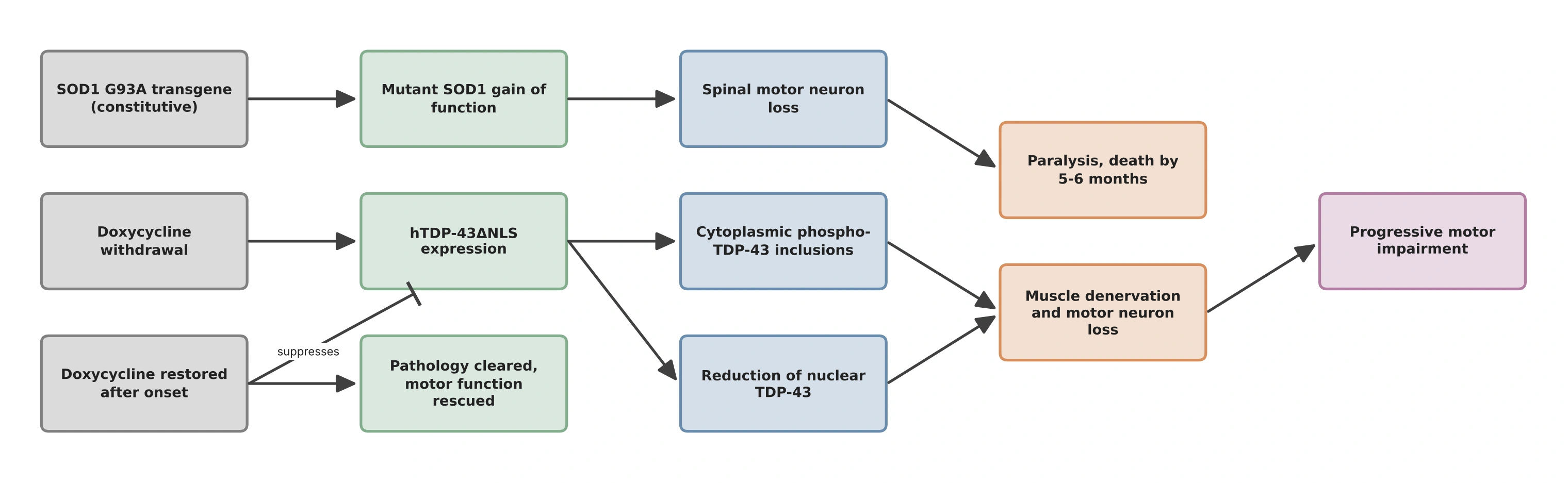
Schematic illustration of the two disease cascades. The SOD1 G93A transgene acts constitutively, while hTDP-43ΔNLS expression in rNLS8 mice is started by withdrawing doxycycline and can be suppressed again after disease onset. Sources: Gurney et al., 1994; Walker et al., 2015.
How well does each model match the pathology of human ALS?
rNLS8 mice reproduce the protein pathology found in the large majority of ALS patients, whereas SOD1 G93A mice reproduce a rare genetic subtype with characteristically different pathology. This is the single most consequential difference between the two models, as it determines whether a target identified in the mouse is also relevant to most patients.
Pathological TDP-43 is found in most human ALS cases
TDP-43 accumulates in most ALS cases, whereas FUS pathology occurs only in a small subset. Together with similar pathology in frontotemporal dementia, these findings support the neuropathological classification of both disorders based on the underlying aggregated protein rather than clinical syndrome alone (Mackenzie, 2010).
SOD1-linked ALS is uncommon, and its inclusions are different
Pooled across 111 genetic studies, SOD1 mutations were found in 14.8% of familial and 1.2% of sporadic ALS in European populations. In Asian populations, SOD1 was the most common ALS gene, accounting for 30.0% of familial and 1.5% of sporadic cases (Zou, 2017). Applied to population-based prevalence data, these figures correspond to an estimated 2,876 SOD1 cases among 121,028 prevalent ALS cases worldwide in 2020, of which 53% were sporadic rather than familial (Brown, 2021).
The pathological distinction is even clearer. In a postmortem study of 111 ALS cases — 59 sporadic, 15 with SOD1 mutations, 11 with SOD1-negative familial ALS, and 26 with dementia — every sporadic, SOD1-negative familial and dementia-associated case had neuronal and glial inclusions positive for both ubiquitin and TDP-43. In contrast, SOD1-mutation cases had ubiquitin-positive inclusions, but none were TDP-43 immunoreactive, and the pathological TDP-43 species detected biochemically in the other groups were absent. The authors concluded that SOD1-mutation cases may degenerate through a different mechanism and may not represent the familial counterpart of sporadic ALS (Mackenzie, 2007). The same pattern was observed in a SOD1 p.Gly141X family, in which both autopsied members had SOD1-positive, TDP-43-negative inclusions, including a proband presenting with frontotemporal dementia-like disease (Nakamura, 2015).
The distinction is strong, but not absolute
In a smaller spinal cord series, TDP-43-positive inclusions were absent in three of four SOD1 cases, while one case had a single TDP-43-positive inclusion. The authors therefore described TDP-43 inclusions in SOD1-linked familial ALS as scarce rather than uniformly absent (Maekawa, 2009). The evidence also comes from relatively small autopsy cohorts, with 15 SOD1 cases in the largest series and four and two cases in the others.
For programs focused on TDP-43 mislocalization, cryptic splicing, or the downstream consequences of nuclear TDP-43 loss, Biospective's background resource on the role of TDP-43 in ALS and FTD covers the biology in more detail.
How do onset, progression, and reversibility differ between the two models?
In SOD1 G93A mice, disease onset follows the transgene's timeline and cannot be prevented. In contrast, disease onset in rNLS8 mice is experimentally controlled through doxycycline withdrawal or a specific doxycycline administration protocol, and disease progression can be halted mid-course by restoring doxycycline or slowed by adjusting its dose. For study design, this distinction is fundamental: SOD1 G93A allows researchers to observe disease progression, whereas rNLS8 allows them to actively control it.
Experimentally controlled disease onset
Because doxycycline suppresses hTDP-43ΔNLS expression, disease onset in rNLS8 mice is triggered by switching the diet rather than being dictated by the animals’ age. This allows cohorts to be induced synchronously, with treatment initiation timed to a defined point relative to disease onset rather than chronological age (Walker, 2015).
Selective vulnerability and the sequence of degeneration
Degeneration in rNLS8 mice is selective, rather than widespread. After eight weeks of transgene expression, motor neuron loss is evident in the hypoglossal nucleus and spinal cord, whereas oculomotor, trigeminal, and facial neurons remain spared (in the “Off Dox” model). Within the spinal cord, fast-fatigable motor neurons degenerate, while slow motor neurons survive through end stage. Axonal withdrawal also follows a selective pattern, occurring first at fast-twitch muscle fibers, while slow-twitch fibers remain innervated (Spiller, 2016). This selectivity has important implications for endpoint design: the choice of muscle sampled can determine whether denervation is detectable at all.
Reversal: what recovers, and what does not
Restoring doxycycline after disease onset reverses several disease-associated features in rNLS8 mice: phosphorylated TDP-43 pathology is cleared, nuclear TDP-43 returns to control levels, further motor neuron loss is prevented, muscle innervation increases substantially, motor impairment improves, and lifespan is extended (Walker, 2015).
However, two important qualifications shape how recovery should be interpreted. First, functional recovery does not reflect replacement of the lost fast-fatigable motor neuron population. Instead, surviving motor neurons sprout to reinnervate vacated endplates (Spiller, 2016). Second, recovery is age-dependent. When transgene expression was induced in mice aged 12 months or older, disease progression was accelerated and functional recovery following transgene suppression was incomplete compared with younger mice. Reinnervation was often only partial, and neuromuscular junctional folds remained more disorganized (Spiller, 2016).
A 2025 preprint adds another dimension: extra-motor behavioral abnormalities emerge early in rNLS8 mice and persist even after motor function recovers. These persistent phenotypes are accompanied by changes in synaptic gene expression and splicing changes, suggesting that motor recovery does not necessarily indicate broader neurological recovery (Luan, 2025).
Extending the therapeutic window
The standard rNLS8 protocol produces relatively rapid disease progression, with approximately four to six weeks of measurable decline. This creates a narrow therapeutic window in which to administer candidate treatments and detect meaningful effects. To address this limitation, Biospective has developed a “Low Dox” version of the rNLS8 model, which produces a less aggressive, more slowly progressing disease course. By extending the period over which disease modification can be assessed, this approach offers greater flexibility for therapeutic intervention and evaluation.
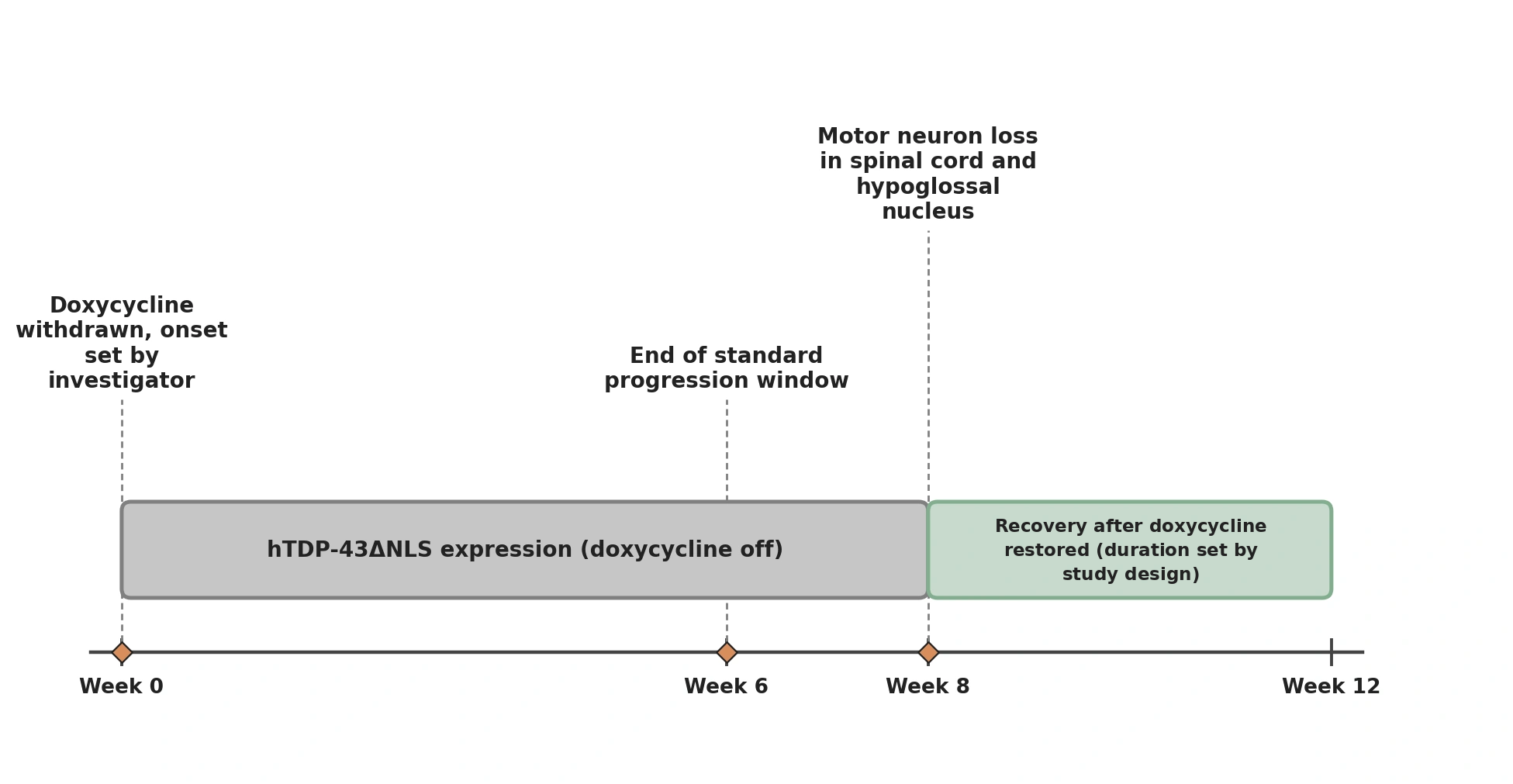
Schematic illustration of an rNLS8 induction protocol based on literature reports: onset is set by withdrawing doxycycline at Week 0, the standard progression window runs to about Week 6, and motor neuron loss in the spinal cord and hypoglossal nucleus is present by eight weeks of expression. The recovery phase begins when doxycycline is restored; its duration is a matter of study design rather than a measured endpoint. Sources: Walker et al., 2015; Spiller et al., 2016
Note that Biospective has developed alternative protocols with different study timelines optimized for evaluating therapeutic interventions. Please contact us to discuss potential study designs for your therapeutic program with our scientists.
Why has SOD1 G93A shown limited clinical translation?
Therapeutic success in SOD1 mice has not translated into effective treatments for human ALS. Published analyses point to two distinct challenges underlying this translational gap: the relatively modest treatment effects being pursued and the substantial biological variability that complicates their detection.
The treatment effects have been modest
A random-effects meta-analysis of treatment trials in SOD1 mice was conducted specifically to investigate this failure of translational research. Among studies in which treatment began presymptomatically, the weighted mean differences between treated and control animals were 12 days for disease onset, 13 days for survival, and 5 days for survival interval. When treatment began at symptom onset, the corresponding differences were 15 days for survival and 8 days for survival interval (Benatar, 2007). These relatively modest effects are difficult to distinguish reliably from the inherent variability of the model.
Biological variability is substantial and systematic
Transgene copy number. Disease onset and survival are directly related to mutant SOD1 transgene copy number. The standard high-copy line, carrying approximately 25 copies, typically reaches end stage at around 130 days. By contrast, a four-copy line develops weakness only from nine months of age; 74% of mice are affected by 18 months, while approximately 20% of mice older than 24 months remain free of motor symptoms (Deitch, 2014). Consequently, copy-number variation or drift within a colony can substantially alter the disease timeline and the endpoints being measured.
Genetic background matters more than sex. A meta-analysis of 97 studies examining disease onset, duration, and lifespan found that SOD1 G93A mice on a C57BL/6 background exhibited delayed onset, longer lifespan, and extended disease duration compared with sex-matched B6SJL mice. Sex effects were also observed, with female B6SJL mice generally showing delayed onset and longer survival than males. However, in C57BL/6 mice, females showed delayed onset without a corresponding survival advantage. The methods used to assess onset — including tremor observation and rotarod performance — also produced substantially different estimates. Overall, genetic background had a greater influence on disease outcomes than sex, despite equivalent mutant SOD1 expression (Pfohl, 2015).
Background effects extend beyond transgene expression. Differences between genetic backgrounds cannot be explained simply by variation in transgene copy number or mutant protein abundance. Even when these factors were matched, C57 and 129Sv mice carrying the SOD1 G93A transgene showed different rates of disease progression. At symptom onset, 1,276 genes were differentially expressed in fast-progressing 129Sv-SOD1G93A mice, compared with 346 in slow-progressing C57-SOD1G93A mice (Q ≤ 0.01). The fast-progressing line showed downregulation of mitochondrial, protein-degradation, and axonal transport pathways, whereas the slower-progressing line showed complement activation alongside neuroprotective genes (Nardo, 2013).
How the field has responded
These sources of variability are well recognized, and efforts to address them have focused largely on improving experimental consistency. Hybrid SJLxC57 SOD1 G93A mice were found to exhibit background-related confounding factors that could increase experimental noise and produce false-positive treatment effects unless adequately controlled. Group sizes of approximately 24 animals were required in the studies discussed. An inbred C57BL/6 SOD1 G93A line with a more consistent disease course was subsequently developed, in part to reduce this experimental burden (Mead, 2011).
Controlling variability does not solve the problem of disease relevance
None of this makes SOD1 G93A a poor model. Rather, it highlights the extent to which experimental variability must be controlled to obtain reliable and reproducible results. But there is a separate limitation that methodological rigor cannot overcome: SOD1-associated ALS accounts for only a small minority of human ALS cases. Reducing variability can improve confidence that an observed treatment effect is real. It cannot establish that the underlying disease mechanism is representative of the broader ALS population. This is a question of construct validity, and it remains distinct from the challenge of experimental reproducibility.
How does model choice affect study duration and cohort size?
Scope Your ALS Model Study
Tell us your mechanism-of-action, your therapeutic modality, and your timeline, and our team will design an rNLS8 study around them: induction schedule, dosing window, and relevant endpoints based on our extensive experience performing efficacy studies in this model.
Scope Your ALS Model Study
Tell us your mechanism-of-action, your therapeutic modality, and your timeline, and our team will design an rNLS8 study around them: induction schedule, dosing window, and relevant endpoints based on our extensive experience performing efficacy studies in this model.
Model selection sets the duration of an experiment, the number of animals needed to detect treatment effects against the model’s inherent variability, and whether a reversal arm can be incorporated at all. SOD1 G93A and rNLS8 impose different experimental constraints, and neither is universally less costly.
Study duration: inherited or adjustable
A conventional therapeutic study in SOD1 G93A mice typically runs for three to four months (Mead, 2011). Standard (Off Dox) rNLS8 mice progress over roughly six weeks following doxycycline withdrawal. Although shorter, this relatively rapid progression can be restrictive for therapeutic studies requiring chronic dosing.
The “Low Dox” version of the rNLS8 model addresses this limitation by slowing disease progression through dietary doxycycline modulation. Biospective typically conducts studies of approximately 8 weeks using this protocol, providing a longer intervention window than the standard Off Dox model. Thus, rNLS8 offers flexibility in determining the experimental timeline rather than imposing a fixed disease course.
Cohort size
For SOD1 G93A mice, published preclinical guidelines explicitly address the need to control experimental variability. In hybrid SJLxC57 mice, background-related confounders can increase biological noise and produce false-positive treatment effects if not adequately controlled. The guidelines therefore recommend litter-matched treatment and control groups, group sizes of 24 animals, transgene copy-number analysis for every mouse enrolled in a therapeutic study, and censoring of data from littermates lost to non-ALS-related events (Mead, 2011).
By comparison, Biospective typically performs studies using 12-15 mice per group in both its Off Dox and Low Dox rNLS8 models.
The experimental arm only rNLS8 makes possible
One distinctive advantage of rNLS8 is the ability to include a reversal arm. Because transgene expression can be suppressed after disease onset by restoring doxycycline, researchers can assess the extent of recovery achievable in a given cohort. This provides an important benchmark for evaluating candidate therapies: rather than measuring treatment effects against untreated disease progression alone, a candidate’s efficacy can also be considered in relation to the recovery possible when the disease-driving transgene is switched off (Walker, 2015). Constitutive models such as SOD1 G93A do not offer this experimental control.
What can Biospective measure in rNLS8 TDP-43 mice?
Biospective provides end-to-end rNLS8 efficacy studies, covering disease induction and therapeutic dosing through fluid biomarkers, electrophysiology, behavioral testing, imaging, and quantitative histopathology. The readouts are selected to reflect the specific pathological and functional changes observed in the model.
Fluid biomarkers
Serum neurofilament light chain (NfL) is among the most treatment-responsive biomarkers reported in rNLS8 mice. In an active immunization study, treatment with a C-terminal TDP-43 peptide containing phospho-Ser409/410 significantly reduced serum NfL, despite no detectable changes in body weight, phosphorylated TDP-43 pathology, or gliosis (Riemenschneider, 2023).
Biospective offers neurofilament light chain measurement in plasma, serum, and CSF, enabling longitudinal biomarker monitoring alongside a broader panel of fluid and cellular biomarkers.
Neuromuscular junction (NMJ) integrity
Because denervation in rNLS8 mice preferentially affects fast-twitch muscle fibers, while slow-twitch fibers remain relatively innervated, muscle selection is critical for detecting disease-associated changes (Spiller, 2016).
Biospective performs neuromuscular junction staining and quantitative analysis to assess innervation status across muscles. Further details are available in our resources on NMJ morphology in ALS models and microscopy of the neuromuscular junction in ALS.
TDP-43 pathology and neuroinflammation
Biospective quantitatively assesses human TDP-43 expression, phosphorylated TDP-43 aggregates (p409/410), and neuroinflammatory changes, including reactive astrocytes and activated microglia. These endpoints are evaluated using multiplex immunofluorescence microscopy and quantitative image analysis, providing complementary measures of pathology and neuroinflammatory response.
Motor function and behavior
Functional assessments include grip strength and longitudinal motor scoring, incorporating measures such as hindlimb clasping, grill agility, and tremor. These endpoints help characterize disease progression and evaluate therapeutic effects. Biospective runs these through motor function testing and broader behavioral testing.
Electrophysiology and in vivo imaging
Biospective performs electrophysiological assessments, including CMAP and MUNE and magnetic resonance imaging (MRI) can be used to assess brain atrophy. Together, these approaches provide longitudinal, non-terminal measures that complement behavioral assessments and endpoint histopathology.
Integrated study conduct
Biospective manages the experimental workflow in-house through our animal services, from disease induction and doxycycline titration through therapeutic dosing, longitudinal assessments, and fluid and tissue collection. Integrating these capabilities within a single study enables multiple complementary endpoints to be collected and evaluated within a coordinated experimental design.
SOD1 G93A or rNLS8: which ALS model is right for your therapeutic program?
For most ALS therapeutic programs targeting mechanisms beyond mutant SOD1, rNLS8 TDP-43 mice are the more relevant model for preclinical therapeutic studies. SOD1 G93A mice, however, remain the appropriate choice for programs specifically targeting SOD1-associated disease. The deciding factor should be the mechanism of action being investigated and its relevance to the intended patient population. TDP-43 proteinopathy is a defining pathological feature in the vast majority of ALS cases (Mackenzie, 2010).
Choose SOD1 G93A when…
Your therapeutic candidate directly targets mutant SOD1, including antisense oligonucleotides (ASOs), gene silencing, SOD1 aggregation, or SOD1 protein handling. In this setting, the model expresses the relevant human disease-associated target, and the genetically defined patient population provides a clear translational rationale. SOD1 G93A also benefits from more than three decades of research, including established experimental protocols, disease-onset criteria, and historical control data (Gurney, 1994; Mead, 2011). It may also be the preferred model when regulatory or scientific reviewers expect continuity with historical SOD1-directed therapeutic studies. These advantages must be weighed against the model’s biological variability. Study designs should account for genetic background and transgene copy number, with appropriate litter matching, group sizes, copy-number analysis, and predefined criteria for excluding animals lost to non-ALS-related events (Mead, 2011).
Choose rNLS8 TDP-43 mice when…
Your therapeutic candidate targets TDP-43 mislocalization, cytoplasmic TDP-43 aggregation, loss of nuclear TDP-43 function, cryptic splicing, or downstream neuroinflammatory and neuroaxonal pathology. SOD1 G93A cannot directly address these mechanisms: SOD1-associated ALS is characteristically distinct from the TDP-43 proteinopathy observed in most other forms of ALS, with TDP-43 inclusions generally absent in SOD1-mutant disease (Mackenzie, 2007; Mackenzie, 2010). rNLS8 is also particularly useful when experimental flexibility is important. Doxycycline-controlled disease induction allows researchers to synchronize disease onset, adjust the progression window, and introduce a reversal arm to assess the extent of recovery possible following suppression of the disease-driving transgene (Walker, 2015).
Why rNLS8 is the better default for most ALS programs
SOD1-associated ALS represents a relatively small proportion of the overall disease population, accounting for approximately 1.2% of sporadic and 14.8% of familial ALS cases in European populations (Zou, 2017). For therapeutic programs that do not specifically target mutant SOD1, the SOD1 G93A model therefore has an important limitation in terms of disease-mechanism relevance. This limitation is compounded by the modest treatment effects reported in pooled analyses of SOD1 mouse studies, with modest improvements in onset or survival, alongside substantial variability associated with transgene copy number and genetic background (Benatar, 2007; Deitch, 2014; Pfohl, 2015). For programs targeting TDP-43 pathology, rNLS8 offers a more directly relevant disease mechanism, experimentally controlled onset, adjustable progression, and the ability to evaluate reversibility.
Contact Us
Our team would be happy to answer any questions about choosing between SOD1 G93A and rNLS8 TDP-43 mouse models for ALS efficacy studies or provide specific information about the neurodegenerative disease models we use for therapeutic efficacy studies.
Our team would be happy to answer any questions about choosing between SOD1 G93A and rNLS8 TDP-43 mouse models for ALS efficacy studies or provide specific information about the neurodegenerative disease models we use for therapeutic efficacy studies.
Discover more about our ALS Models
Biospective maintains a range of rodent models for ALS and related TDP-43 proteinopathies, with validated readouts and study designs for each.
ALS Models
Our full range of rodent models for amyotrophic lateral sclerosis, with the readouts and study designs available in each.
TDP-43 Transgenic Models
Transgenic models of TDP-43 proteinopathy, including the inducible rNLS8 hTDP-43ΔNLS line discussed on this page.
TDP-43ΔNLS Mice for Drug Development
How the inducible TDP-43ΔNLS model is applied in therapeutic efficacy programs, from induction to endpoint selection.
ALS Models
Our full range of rodent models for amyotrophic lateral sclerosis, with the readouts and study designs available in each.
TDP-43 Transgenic Models
Transgenic models of TDP-43 proteinopathy, including the inducible rNLS8 hTDP-43ΔNLS line discussed on this page.
TDP-43ΔNLS Mice for Drug Development
How the inducible TDP-43ΔNLS model is applied in therapeutic efficacy programs, from induction to endpoint selection.
FAQs
FAQs
References
Keywords
Related Content
Related Content