


PS19 (P301S) Mice vs. PS19 Mice with Tau PFF Seeding vs. AAV-hTau Mice: How to Choose a Tau Mouse Model
Three tauopathy mouse models, compared on timeline, endpoints, and fit. Two models are available at Biospective; the third is the published baseline they are measured against.
 Why model choice is a strategic decision, not a default
- PS19 (P301S) alone: the published baseline
- PS19 + tau PFF seeding: what it is built to answer
- The AAV-hTau model of PSP & CBD: what it is built to answer
- Three-way comparison matrix
- Timelines, throughput, and study economics
- Endpoint & translational biomarker strategy
- Which model fits your program?
- When to run both models in sequence
Summary
Resource Summary
Three tauopathy mouse models are frequently considered for tau-targeted drug development, and they are not interchangeable. The PS19 (P301S) transgenic mouse expresses mutant human tau throughout the brain and develops tau aggregates, neuroinflammation, cognitive deficits, and MRI-detectable atrophy over approximately 6 to 12 months. It is the model underlying much of the published literature and is best understood here as a reference condition rather than as a drug-testing platform offered by Biospective.
Biospective’s tau PFF seeding model injects sonicated recombinant tau preformed fibrils into the hippocampus ± overlying cerebral cortex of PS19 mice at ~8 weeks of age. It produces highly penetrant, spatially stereotyped NFT-like pathology, accompanied by neuroinflammation, neurodegenerative changes, and elevated NfL within 2 to 3 months.
Biospective’s AAV-hTau (2N4R) model of PSP & CBD delivers wild-type human 4R tau unilaterally to the substantia nigra (or other brain regions), producing focal 4R pathology, dopaminergic neurodegeneration, and asymmetric Parkinsonian motor deficits in approximately 6 weeks, with a contralateral AAV-null control in each mouse.
Biospective offers the PFF-seeded and AAV-hTau models as end-to-end preclinical programs. PS19 alone is included here for context because its published natural history provides a baseline against which the accelerated pathology in the seeded model can be understood.
~6 weeks
AAV-hTau time to robust, quantitative endpoints
2–3 months
PS19 + tau PFF spreading window after injection at 8 weeks
~100%
Penetrance of induced pathology in PFF-injected mice
6–12 months
Published PS19 natural history, for reference
~6 weeks
AAV-hTau time to robust, quantitative endpoints
2–3 months
PS19 + tau PFF spreading window after injection at 8 weeks
~100%
Penetrance of induced pathology in PFF-injected mice
6–12 months
Published PS19 natural history, for reference
Available at Biospective
AAV-hTau (2N4R) Mouse Model of PSP & CBD
Validated high-titer vector stock held in-house for on-demand study start
Unilateral SNc injection with contralateral AAV-null control
Validated for tau pathology, TH-positive neuron loss, striatal denervation, neuroinflammation, 7T MRI atrophy, motor deficits, and CSF/plasma tau, pTau-T181, NfL, and GFAP
Available at Biospective
Tau PFF Seeding Mouse Model (PS19 host)
Sonicated recombinant tau PFFs injected into hippocampus ± overlying cortex at 8 weeks
Highly penetrant, reproducible seeding and spreading along anatomically connected networks
Sponsor-supplied inocula, human brain extracts, and alternative injection sites supported
Published baseline - not offered as a standalone model
PS19 (P301S) Transgenic Mouse, Unseeded
The reference condition described across the tau literature
Spontaneous, age-dependent onset with substantial variability between animals and cohorts
Included here so the acceleration achieved by PFF seeding can be understood against it
Why model choice is a strategic decision, not a default
Tauopathies are a group of neurodegenerative disorders defined by abnormal aggregation of tau, a microtubule-associated protein that maintains neuronal architecture. In disease, tau can become hyperphosphorylated, detach from microtubules, and accumulate intracellularly. Tau dysfunction and aggregation are associated with disruption of neuronal cytoskeleton function and contribute to neurotoxicity and cell death (Wang, 2016). More than 26 distinct tauopathies have been described, spanning Alzheimer’s disease, FTDP-17, and progressive supranuclear palsy (Sexton, 2022).
Tau-directed drug discovery has accordingly diversified across aggregation inhibitors, immunotherapies, and kinase- and degradation-based approaches, each of which places different demands on the preclinical model used to test it (Soeda, 2020).
That heterogeneity matters for preclinical strategy. A model based on seeded tau aggregation and propagation in a P301S transgenic host represents a different disease context from a focal model expressing wild-type 4R tau in the nigrostriatal system. These models have different tau substrates, vulnerable circuits, functional readouts, and translational considerations. Choosing between a seeded transgenic model and a vector-induced focal model therefore determines what questions your efficacy study can answer and how quickly it can answer them (Götz, 2019). For broader context on the full panel available, see our tauopathy models overview and our rodent models portfolio.
PS19 (P301S) alone: the published baseline
The reference condition against which both induced models should be read.
Availability note: Biospective does not offer the unseeded aged PS19 mouse as a standalone drug-testing model. We describe its natural history here because it is the published foundation for tau seeding work and because the timelines below explain why our studies use PFF seeding rather than relying on spontaneous onset.
PS19 mice express human tau carrying the P301S missense mutation under the mouse prion protein (PrP) promoter. This strong constitutive promoter drives transgene expression at approximately five times endogenous levels (Yoshiyama, 2007).
P301S is associated with altered tau aggregation propensity and disease-associated tau pathology. The mutation has been studied in relation to tau conformational changes, phosphorylation, microtubule interactions, and aggregation (Strang, 2019).
Pathology appears across many regions, including the cerebral cortex, hippocampus, brainstem, and spinal cord. This widespread distribution provides opportunities to study tau pathology across multiple neural systems, although it does not reproduce the full anatomical or cellular features of any one human tauopathy (Alves, 2025). Natural-history milestones reported in the literature include:
Two features of this natural history drive the case for seeding. First, the in-life phase can extend to 6-9 months before the endpoints most programs need are established. Second, onset and phenotype vary between animals and cohorts, as documented across independent studies (Alves, 2025). This variability can reduce statistical power when treatment effects are being evaluated.
PS19 + tau PFF seeding: what it is built to answer
A seeded transgenic model for tau propagation on a drug development timeline.
Biospective induces tauopathy by stereotaxic inoculation of sonicated recombinant human tau preformed fibrils (hTau PFFs) into the hippocampus ± overlying cerebral cortex of PS19 transgenic mice [B6;C3-Tg(Prnp-MAPT*P301S)PS19Vle/J]. The injection site follows the approach originally reported by Iba and colleagues (Iba, 2013). Injections are performed with digital stereotaxic devices and automated microinjectors, typically at 8 weeks of age, with a spreading window of 2 to 3 months before endpoint collection.
The PFFs promote the templated aggregation of tau, with pathology developing at the injection site and appearing in anatomically connected brain regions. This seeding and propagation behavior is consistent with the prion-like properties attributed to tau in human disease (Iba, 2013).
Key features:
Seeded, spatially stereotyped tau pathology
Phosphorylated tau inclusions and NFT-like aggregates develop at the injection site and appear in downstream connected regions in a reproducible spatiotemporal pattern. Biospective has observed high penetrance of induced pathology in its characterized cohorts.
Robust neuroinflammation
Microgliosis and astrogliosis occur in regions accumulating tau aggregates, providing opportunities to study the glial response to tau pathology and to evaluate anti-inflammatory and immunomodulatory therapeutic approaches.
Neurodegeneration with a fluid biomarker
Progressive neuronal and process loss are accompanied by elevated neurofilament light chain (NfL) in plasma and CSF.
Quantitative pathology readouts
AT8 immunohistochemistry and multiplex immunofluorescence enable quantification of phosphorylated tau burden and associated glial responses across selected brain regions.
Because pathology is induced rather than awaited, cohort timing is set by the surgery date, and the spread pattern is sufficiently reproducible to support treatment-group comparisons across brain regions. The model can also accommodate sponsor-supplied inocula, including oligomers or human brain extracts, in place of recombinant fibrils, as well as alternative injection sites. These include the anterior olfactory nucleus (AON), where we have examined whether the spatial spread pattern parallels that of our α-synuclein PFF model.
This is the model to choose when the therapeutic hypothesis concerns tau seeding, aggregation, propagation, or the glial response to spreading pathology. It has been used at Biospective across small molecules, antisense oligonucleotides, AAV gene therapies, and antibody- and vaccine-based immunotherapies.
The AAV-hTau model of PSP & CBD: what it is built to answer
A focal, rapidly inducible 4R tauopathy model for efficacy screening and go/no-go decisions.
Biospective’s model delivers AAV vectors encoding wild-type human 2N4R tau unilaterally into the substantia nigra pars compacta (SNc) of ~12-week-old C57BL/6 mice, using digital stereotaxic systems with automated microinjectors. The contralateral hemisphere receives AAV-null, giving each animal an internal control.
Within weeks, the model develops several features relevant to human 4R tauopathies with Parkinsonian features:
Multiple tau pathology readouts
Phosphorylated tau (AT8, pTau181), conformationally altered tau (MC1), oligomer-enriched tau (TOC1), granular tau aggregates, and D421-cleaved tau are detected within neuronal soma and neurites.
Dopaminergic neurodegeneration
Substantial loss of TH-positive neurons in the SNc, with denervation of striatal terminals and reduced striatal dopamine.
Fluid biomarkers
Significantly elevated CSF and plasma total tau, plasma pTau-T181, plasma GFAP, and CSF/plasma NfL versus AAV-null controls.
Robust neuroinflammation
The model exhibits neuroinflammatory changes, including increased Iba-1 immunoreactivity and GFAP-positive astrogliosis, together with elevated midbrain IFN-γ, IL-1β, IL-2, IL-6, and TNF-α. These findings can be evaluated alongside the inflammatory changes reported in transgenic tauopathy models (Jati, 2025).
Asymmetric motor deficits
Cylinder test forelimb asymmetry, tail suspension swing bias, reduced rotarod latency, hindlimb clasping, and early SNAP sensorimotor asymmetry.
Robust endpoints are captured by ~6 weeks post-injection. Unlike the P301S-based models above, which depend on a MAPT mutation to drive tau pathology (Strang, 2019), this model produces pathology following expression of wild-type human tau. This provides a complementary experimental context for studying wild-type 4R tau pathology relevant to primary 4R tauopathies, including PSP and CBD, in which a causal MAPT mutation is not present. Biospective maintains validated high-titer vector stock in-house for on-demand study start.
Three-way comparison matrix
The same program question answered three different ways.
AAV-hTau (2N4R)
Focal induced 4R tauopathy
Vector-induced, targeted, unilateral (or bilateral)
Wild-type human tau, no disease-associated MAPT mutation
Parkinsonian motor and nigrostriatal endpoints
~6 week in-life window
PS19 + tau PFF
Seeded transgenic tauopathy
Fibril-seeded in P301S host at 8 weeks
Seeding and spreading biology, with an accelerated study timeline
pTau burden, glial response, and NfL
2–3 month spreading window
PS19 alone
Published baseline
Spontaneous, age-dependent onset
Widespread brain phenotype, including cognitive changes
Variable onset between animals and cohorts
6–12 month in-life window
PS19 alone
Published baseline
Spontaneous, age-dependent onset
Widespread brain phenotype, including cognitive changes
Variable onset between animals and cohorts
6–12 month in-life window
Comparison of the two tauopathy models offered at Biospective against the published PS19 baseline.
Timelines, throughput, and study economics
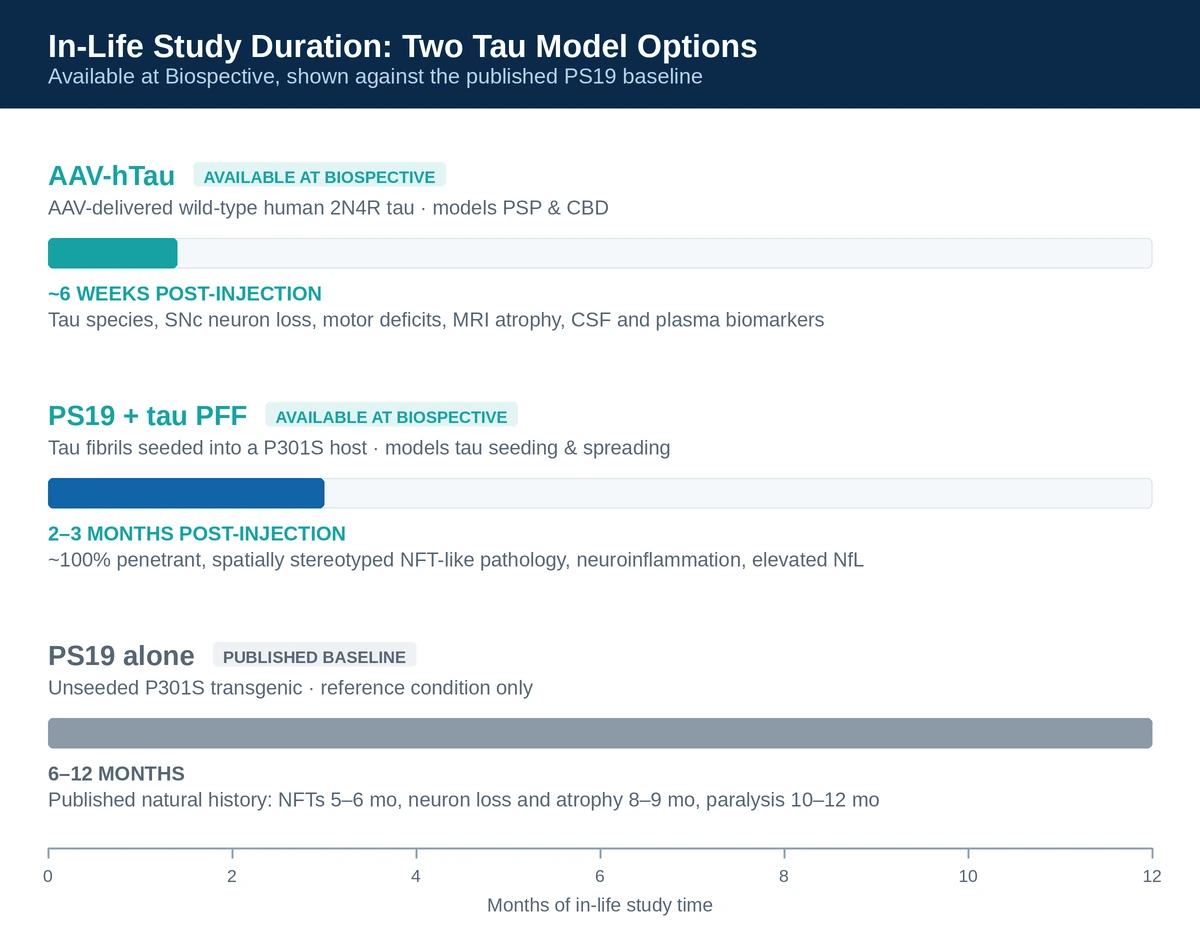
Indicative in-life timelines. PS19 alone is shown as the published reference condition; Biospective offers the PFF-seeded and AAV-hTau models, both of which compress the window to quantitative endpoints.
The practical difference is programmatic. Waiting for spontaneous PS19 pathology can be a multi-quarter commitment that includes breeding, genotyping, aging, and long-term dosing before the endpoints most programs need are established. Seeding shortens this timeline: injection at 8 weeks of age followed by a 2- to 3-month spreading window turns the same broad transgenic background into a study that can read out within a quarter, with pathology induced in a highly penetrant and reproducible manner. The AAV-hTau model compresses the window further, to roughly six weeks, for programs focused on wild-type 4R tau pathology.
Study-design note. The variability that can drive larger group sizes in unseeded PS19 studies includes biological variability in onset and phenotype, which has been documented across independent cohorts (Alves, 2025; Patel, 2022). Both induced models address this challenge differently: PFF seeding synchronizes the induction of pathology and produces a reproducible spatial distribution, while the AAV-hTau model’s unilateral design provides a within-animal control so each mouse contributes a paired comparison.
Endpoint & translational biomarker strategy
Match the readout to the clinical endpoint your program will ultimately need.
Both offered models are supported by the same range of CRO services — in vivo imaging, behavioral testing, fluid and cellular biomarkers, and quantitative histology. The distinction lies in which endpoints carry the greatest interpretive weight and how they relate to clinical measures used in relevant tauopathy research (Sexton, 2022).
Both models are supported end-to-end at Biospective, from stereotaxic induction through in vivo imaging, biofluid assays, and quantitative digital pathology.
Related Services
Tau histology & mIF
AT8 IHC and multiplex panels for pTau, MC1, TOC1, granular and cleaved tau with associated glial markers, quantified by PERMITS™.
Stereotaxic surgery
Digital stereotaxic delivery of PFFs, sponsor-supplied inocula, or AAV vectors to validated or custom targets.
Fluid & cell biomarkers
Ultrasensitive CSF and plasma assays for NfL, total tau, pTau-T181, GFAP, and multiplex cytokine panels.
ONE COHORT, MANY READOUTS
Connect tau pathology to function in the same animals
Because histology, imaging, behavior, and biofluids can be collected from the same mice, a drug-induced reduction in tau burden can be evaluated alongside potential downstream effects on neuronal integrity, brain structure, and motor or cognitive performance.
Which model fits your program?
Both options below are available at Biospective.
Choose AAV-hTau when
Your indication is a primary 4R tauopathy, such as PSP or CBD.
You need a Parkinsonian motor phenotype with nigrostriatal degeneration.
Your mechanism requires testing against wild-type human 4R tau rather than P301S mutant tau.
Speed matters: dose-ranging, triage, or a go/no-go decision on a quarterly cadence.
You want a paired within-animal control that may improve statistical efficiency.
Choose PS19 + tau PFF when
Your mechanism targets tau seeding and propagation.
You need a spatially reproducible, highly penetrant pathology for region-by-region comparison.
You are testing immunotherapies, ASOs, or gene therapies against spreading tau pathology.
You want to inject sponsor-supplied material or human brain extract.
You need to investigate the glial response in regions accumulating tau pathology.
And if you were considering unseeded PS19: If the primary endpoint is tau aggregation and spatial distribution, PFF seeding can reproduce selected aspects of PS19 pathology on a substantially shorter timeline than waiting for spontaneous onset.
When to run both models in sequence
For many tau programs, the two offered models are complementary rather than competing. For mechanisms relevant to both wild-type 4R tau pathology and tau seeding/propagation, one possible sequencing strategy is to use the AAV-hTau model as a rapid first-pass filter, establishing target engagement, CNS exposure, dose–response, and effects on selected tau readouts and NfL within weeks. Surviving candidates can then be evaluated in PFF-seeded PS19 mice, where seeding, propagation, and the glial response to spreading pathology can be interrogated directly.
This ordering front-loads rapid screening decisions and reserves the longer study for compounds that have already met an initial efficacy and target-engagement threshold. Where a program spans both FTLD-tau and 4R indications, running both models can also produce a broader tauopathy data package than relying on a single model— an approach consistent with the need to evaluate therapeutic hypotheses across complementary experimental systems (Götz, 2019). Our amyloid-β and tau co-pathology model extends that package further where amyloid-β interactions are part of the hypothesis.
Biospective delivers both models under one roof: stereotaxic model induction, longitudinal behavioral testing, in vivo MRI, biofluid collection and assays, and quantitative histopathology, with analysis integrated into a single interpretable report.
PARTNER WITH BIOSPECTIVE
Ready to test your tau therapeutic in the right model?
Two induced tauopathy models — AAV-hTau for selected 4R tauopathy features, PFF-seeded PS19 for seeding and spreading — run end-to-end under one roof
Validated vector and fibril preparation in-house for rapid study start-up, without waiting on spontaneous onset
Sponsor-supplied inocula, human brain extracts, and custom injection targets accommodated
Experience with small molecules, antibodies and vaccines, antisense oligonucleotides, and AAV gene therapies
Tau pathology, neuroinflammatory measures, MRI, motor and cognitive testing, and CSF/plasma biomarkers from the same animals
Summary
Biospective offers two models that address limitations associated with relying on spontaneous PS19 pathology for drug testing. Seeding PS19 mice with tau preformed fibrils (PFFs) at 8 weeks of age produces highly penetrant, spatially reproducible NFT-like tau pathology and neuroinflammation, accompanied by neurodegeneration and elevated NfL within 2 to 3 months. This model is suited to therapeutic mechanisms acting on tau seeding and propagation. The AAV-hTau model produces 4R tau pathology following expression of wild-type human 2N4R tau in the substantia nigra, with dopaminergic neuron loss, asymmetric Parkinsonian deficits, and complementary fluid and imaging biomarkers in roughly six weeks, using a within-animal AAV-null control.
For programs whose mechanisms span both wild-type 4R tau pathology and tau seeding/propagation, the models can be used sequentially: AAV-hTau for rapid proof-of-concept, followed by PFF-seeded PS19 for confirmation in a propagation-focused paradigm. For mechanisms specific to either biology, a single model may be more appropriate. Explore our full portfolio of tauopathy mouse models and our rodent model capabilities.
Discover more of our Tauopathy Models
Tau Mouse Model of PSP & CBD
Validated AAV-hTau model with Parkinsonian features, translational biomarkers, and interactive microscopy.
Tau PFF Seeding Mouse Model
Accelerated, synchronized tau pathology via stereotaxic delivery of recombinant tau preformed fibrils.
Amyloid-β & Tau Co-Pathology Model
For programs where amyloid and tau interactions are central to the therapeutic hypothesis.
FAQs
FAQs